Environmental Insights:
Posted on: Sep 29, 2026
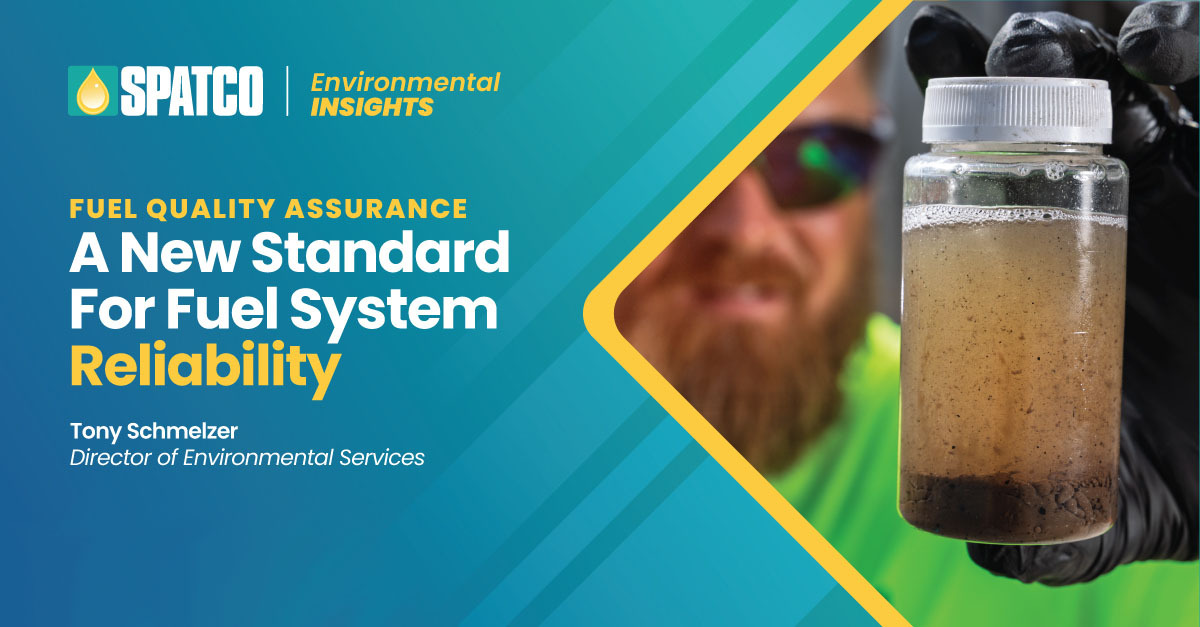
Introducing Fuel Quality Assurance: A New Standard for Fuel System Reliability
By Tony Schmelzer
Director of Environmental Services
SPATCO Energy Solutions
About Environmental Insights
Environmental Insights explores the conditions, technologies, and maintenance practices shaping fuel quality, environmental compliance, storage systems, and operational reliability. It is built from what SPATCO teams see in the field and from the technical guidance shaping how modern fuel systems should be managed.
Key Takeaways
- Modern diesel storage requires a different level of discipline than it did a generation ago.
- Many costly fuel problems begin inside the tank long before a filter plugs or a generator hesitates.
- Water, fuel age, contamination, and system conditions matter as much as delivered product.
- Fuel Quality Assurance is best understood as a framework for visibility, monitoring, and informed maintenance decisions.
The Fuel Changed. The Risk Changed.
For a long time, diesel fuel was treated like a passive commodity. Store it properly. Keep obvious water out. Replace filters when they became a problem. In many settings, that approach seemed good enough.
It is no longer good enough.
The reason is not simply that operations became more demanding. The fuel changed, the equipment changed, and the consequences of getting fuel condition wrong became more expensive. EPA notes that diesel once contained sulfur levels as high as 5,000 ppm before federal sulfur regulation, and that ultra-low sulfur diesel was phased in at 15 ppm across on-road and then nonroad markets. At the same time, biodiesel pathways became normalized in the fuel pool, and renewable diesel emerged as a distinct but chemically different low-carbon pathway. The result is a more complex storage environment than the one many operators learned two or three decades ago.
The impact of this fuel formulation is easy to underestimate because most fuel-quality failures do not begin with a dramatic event. They begin quietly, inside the storage system.
At SPATCO, we see that pattern across retail fueling, commercial fleets, municipalities, healthcare facilities, utilities, emergency services, and backup-power systems. A clogged filter, a slow dispenser, an injector problem, an unreliable generator start, or an unexpected service call is usually not the beginning of the story. It is the moment the story becomes visible.
That is the context behind SPATCO Fuel Quality Assurance.
It is not simply another maintenance service. It is a more disciplined way to think about fuel-system reliability.
Fuel Quality Does Not End at Delivery
When people hear the phrase fuel quality, they often think of the delivered product. In practice, fuel quality is shaped just as much by what happens after delivery: storage conditions, water intrusion, fuel age, microbial activity, environmental exposure, housekeeping, and system design. Over time, the tank determines whether fuel remains stable or whether conditions begin developing that the operation cannot see.
That distinction matters because many fuel problems do not start with a bad load of fuel. They develop after the fuel arrives.
The First Symptom Is Rarely the First Problem
The most common gateway problem is water. The research repeatedly emphasizes that water can enter storage systems through ordinary pathways: deliveries, condensation, vents, seals, fittings, and day-to-day temperature cycling. It can also exist in forms that are not immediately obvious to the eye. In biodiesel, the water story becomes more sensitive because blends can hold more water and create conditions that support degradation and microbial activity more readily than older operating assumptions would suggest.
Operators tend to notice downstream effects. Filters require replacement more often. Dispensing slows. Equipment becomes inconsistent. Alarms recur. Backup systems raise questions no one wants to be asking during an outage or an emergency. Those events can look disconnected when viewed one at a time. They are often linked by conditions that have been developing inside the tank and the fuel system for longer than anyone realized.
EPA’s diesel corrosion findings should give every operator pause. In its study of 42 diesel underground storage tank systems, 83% showed moderate or severe corrosion of internal metal components. EPA also notes that many owners were not aware of the problem before inspection. That is an important reminder that the absence of a visible failure is not the same thing as a healthy storage system.
Fuel Quality Is a Reliability Issue
Retail operators need consistent dispenser performance. Fleet operators need dependable vehicle availability. Municipalities and emergency services need fuel that performs when conditions are least forgiving. Hospitals, utilities, telecom sites, and critical backup-power systems depend on stored fuel as part of a larger continuity plan. In every one of those environments, the real question is not whether a tank can hold fuel. It is whether the fuel can be trusted when the operation depends on it.
Organizations with the lowest tolerance for failure have already moved toward a more proactive model. The research supporting this series points to annual fuel-quality testing requirements or guidance in critical standby applications, growing emphasis on compatibility and corrosion awareness, and a broader shift toward condition-based maintenance rather than assumptions inherited from legacy fuel practices. The same logic appears in broader operations and maintenance guidance as well.
That shift in thinking is the foundation of Fuel Quality Assurance.
A More Proactive Approach to Fuel Quality
Fuel Quality Assurance is designed to help organizations move from symptom-based response to documented fuel stewardship. Instead of waiting for contamination or degradation to disrupt operations, it creates a structured process for understanding current fuel condition, identifying developing issues earlier, documenting system health over time, and making better maintenance decisions before minor problems become larger events.
Depending on the site and the operating profile, that can include recurring inspections, fuel sampling and visual analysis, treatment where appropriate, reporting, trend monitoring, and recommendations based on observed conditions rather than assumptions. The point is not to force every site into the same corrective action. The point is to establish a baseline, monitor what changes, and respond proportionately.
That distinction is important.
Most facilities do not need to begin by assuming they need polishing, tank cleaning, repairs, or aggressive treatment. They need clarity. They need an objective understanding of what is happening inside the system today. Sometimes that process confirms the fuel is in good shape. Sometimes it reveals early warning signs that would otherwise have stayed hidden until they became more expensive to address.
Either way, the value begins with visibility.
No single discussion can cover fuel quality in full. In the months ahead, Environmental Insights will continue to build the logic outward from this point: how modern diesel evolved, why water becomes such a persistent risk, what develops at the fuel-water interface, how microbial activity and corrosion become operational problems, what fuel samples can really tell you, and how testing, cleaning, polishing, repair, and long-term monitoring fit together as part of a modern fuel-management discipline.
At SPATCO, we believe confidence begins with understanding the condition of the fuel system, not assuming that yesterday’s performance guarantees tomorrow’s result.
Field Notes
One thing I have learned over the years is that fuel-quality conversations usually do not begin with a catastrophic failure. They begin with a question.
A generator that does not seem to run quite the way it used to.
Filters that are being changed more often than expected.
A fuel sample that raises more questions than answers.
Sometimes the operation is still running well enough that no one feels urgency. Something just seems off.
That is usually the right moment to take a closer look. Not because every site has a major problem, but because it is easier to make sound decisions when you are working from evidence instead of assumptions. In our experience, the most useful first step is often the simplest one: establish a baseline, document what is there, and let the condition of the system tell you what should happen next.
About the Author
Tony Schmelzer
Director of Environmental Services
SPATCO Energy Solutions
Tony Schmelzer leads SPATCO’s Environmental Services division, working with organizations across retail fueling, commercial fleets, municipalities, healthcare, utilities, emergency services, and critical infrastructure to address fuel quality, environmental compliance, tank conditions, and long-term system reliability.
Connect
To discuss your facility, ask a question, or schedule a Fuel Quality Assurance consultation centered on fuel sampling, professional assessment, and reporting, contact:
SPATCO Energy Solutions
info@spatco.com